Engineering a Texture You Look Forward To
Structure gives it shape. Water opens it up. Your hands bring in the air.
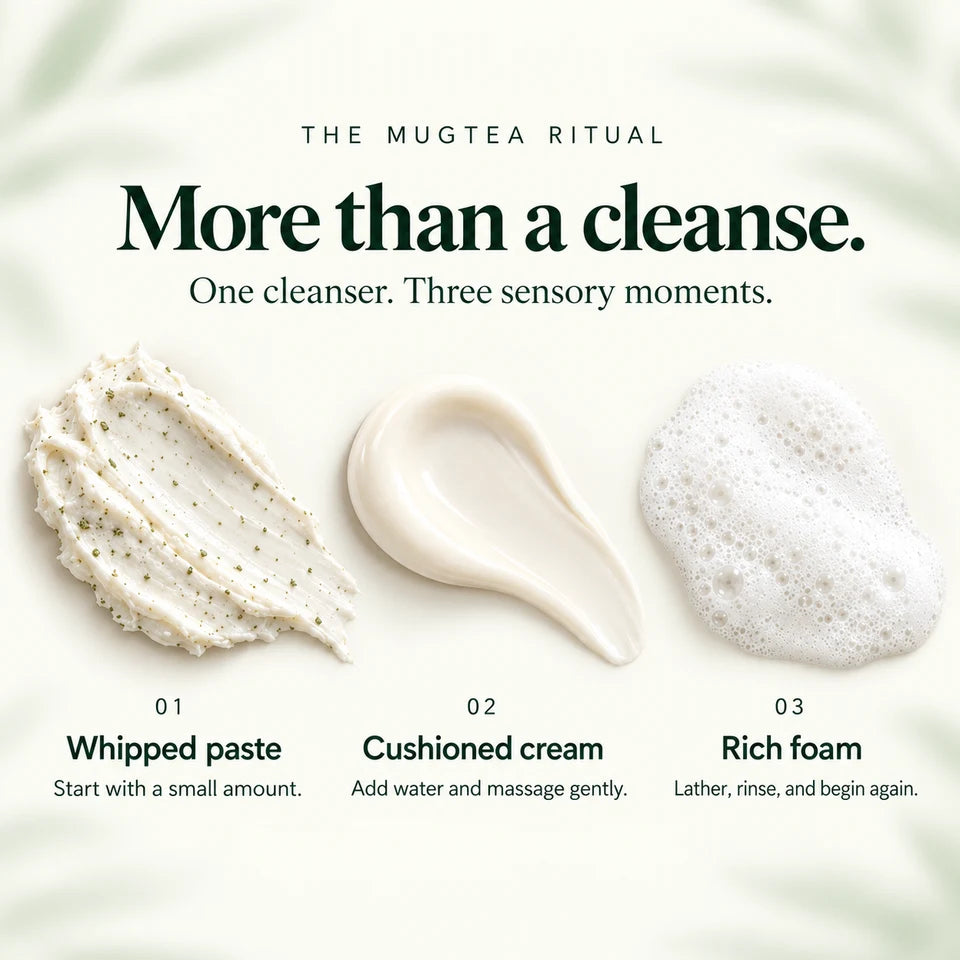
Mugtea goes from paste to cream to foam through three things: a structured cleansing base, added water, and movement. Structuring ingredients give the paste its body. Water loosens it into a spreadable cream. Massage works in air, and the surfactants stabilise the bubbles that become lather. Same formula, three ways to handle it.
Start with your fingertips
Squeeze a little Mugtea out. It holds its shape for a second. There’s something to pick up.
Add water, and the resistance drops. Paste turns to cream.
Keep going and tiny bubbles fill the cream.
You feel the sequence before you know the chemistry. The chemistry is still worth knowing, because it tells you what the water does, what your hands do, and where the cleansing happens.
Paste: how a cleanser gets its body
A paste has to hold together when it leaves the tube and still spread easily at the sink. That balance comes from the whole formulation, not from one ingredient.
The SCI-led surfactant blend is the cleansing foundation, and it shapes the character of both paste and lather. Stearic acid, myristic acid and cetearyl alcohol add body. Xanthan gum and magnesium aluminum silicate manage thickness and flow. Glycerin and water make up the liquid the rest sits in, and dispersed solids such as microfine kaolin add to what you feel. Cetearyl alcohol is a standard bodying, viscosity-building ingredient (Croda’s ingredient reference), and magnesium aluminum silicate often works alongside gums in thickening systems (Vanderbilt’s formulation reference).
Thick isn’t the goal. Everything has to be mixed evenly enough that the product dispenses, spreads and rinses the way it should. Shape in the tube, movement in your hands.
Cream: what the water changes
Mugtea already contains water. What you add at the sink changes the proportions and helps the paste disperse. Work it between wet fingertips and the formula spreads over a bigger area and loosens. That’s the creamy stage, before the lather arrives.
If it feels stiff, you’ve probably used too little water. A splash gives it room to move, and light movement does the rest of the spreading. The cream is the handoff between a product that holds together and a wash that glides over wet skin.
Water is part of how you use this texture.
Foam: where the air comes in
Water isn’t enough on its own. Movement matters.
As you massage, you fold air into the diluted cleanser. Surfactants gather at the boundary between air and water and help steady the thin films around each bubble. Lots of bubbles together make foam. How well they form and hold depends on the surfactant system and the mixture around it, which is what research on surfactants at air–water interfaces looks at. Read the research.
Mugtea’s SCI-led blend is built for a creamy lather, and you build that lather at the sink. It’s separate from any air worked in during manufacturing, and a whipped look alone doesn’t tell you how much air a paste holds. What you can observe is the change under your fingers.
Where the cleansing happens
The lather makes the change visible, but the cleansing belongs to the surfactant system. It meets oily residue and helps it disperse into water you rinse away. That can happen while the product is still creamy.
A bigger pile of foam doesn’t mean stronger cleansing. Foam volume, cleansing performance and skin comfort are separate properties of a finished formula. So don’t chase the biggest lather. You want a wash that spreads easily, removes the day’s buildup and rinses clean.
What texture can tell you
A structured paste gives you a portion you can see. Cream helps you distribute it. Lather changes the feel as you massage. Rinsing carries wash and residue away.
Those are things you can check yourself. Does it spread with a little water? Can you work it with gentle fingertips? Does it rinse away readily? Texture tells you about the experience of using a cleanser. It can’t tell you about treatment results or mildness.
Let the water do its part
Start with wet skin and wet hands, using the amount on the pack. Add a little water as you spread, let the paste soften, then massage gently while the lather builds.
If it’s stiff, add water instead of pressing harder. Rinse well and pat dry. Gentle fingertips and lukewarm water give the experience your skin will love.
A texture worth looking forward to
A paste that holds. A cream that spreads. A foam you build.
